
Things you might see at a garage sale:
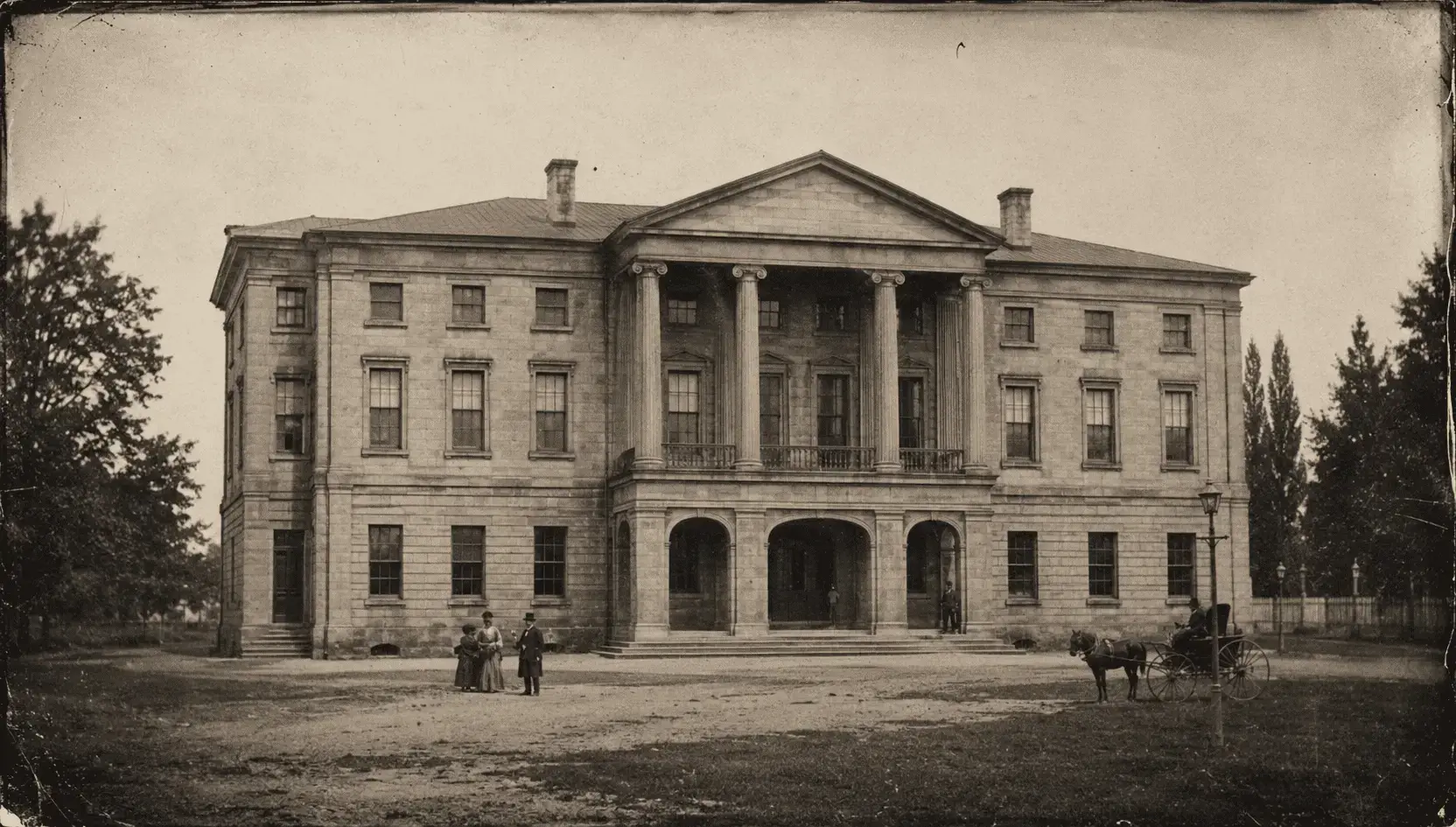
This photograph was hidden away inside the cover of a book. I didn’t know anything about it until after I got home with my treasure trove. The original is about 8×10 in size, and from the type of paper, it is clear that it is definitely not a modern re-print of an old negative. In other words, this one is genuine. It is, what the archives call it, archival-quality.
There is no writing anywhere on this work except for a hand-written note on the reverse: “Provincial Building with Court House at right”. There is no date, no photographer’s name, no owner’s name; not even the book that it was stuck inside was of any use because it was a bird book.
Where was this photograph taken? Obviously, it had to have been taken before a “Provincial Building” somewhere. Process of elimination leads to an answer almost immediately, especially since there is plenty of such pictures on the Internet.
And how does it relate to copyright? Well, for one thing, here’s where the Fathers of Confederation made the decision that it was to be the federal, rather than the provincial, government which had responsibility for copyright:
The Examiner, you will perceive, gives a classification of the subjects which would come under the supervision of the Confederate Legislature. I am apt to think that this is rather an imperfect list. I have what I conceive pretty good authority for supposing that the list is larger, and that it would embrace currency, trade, banking, usury laws, bankruptcy, insolvency, sea fisheries, light houses, navigation, coinage, weights and measures, interest, marriage and divorce, naturalization, telegraphs, patents and copyrights, census, immigration, postal service, Intercolonial works of all kinds, railways, canals, harbors, militia and defence, criminal law, and like subjects; leaving to the local Legislatures such subjects as roads and bridges, agriculture, hospitals and charitable institutions, prisons, mines, minerals, timber and public lands, education, inland fisheries, police and summary punishment of crimes, and such like.
From Library and Archives Canada’s re-publication of public-domain newspaper article “Morning Chronicle” (Halifax) September 10, 1864.
However, going back to basics, this is a “work” under the Copyright Act. At some stage, there was subsistence of copyright in this work. Is there subsistence of copyright now?
We do not know.
The Copyright Act states:
“artistic work” includes paintings, drawings, maps, charts, plans, photographs[…]
5. (1) Subject to this Act, copyright shall subsist in Canada, for the term hereinafter mentioned, in every original literary, dramatic, musical and artistic work if any one of the following conditions is met:
(a) in the case of any work, whether published or unpublished, including a cinematographic work, the author was, at the date of the making of the work, a citizen or subject of, or a person ordinarily resident in, a treaty country[…]
Do we have any idea about who has written the work? We don’t even know where to begin.
Furthermore, according to the Copyright Act:
6. The term for which copyright shall subsist shall, except as otherwise expressly provided by this Act, be the life of the author, the remainder of the calendar year in which the author dies, and a period of fifty years following the end of that calendar year.
Do we know the identity of the author of the work? Nope. Still don’t. So we turn to the next section:
6.1 Except as provided in section 6.2, where the identity of the author of a work is unknown, copyright in the work shall subsist for whichever of the following terms ends earlier:
(a) a term consisting of the remainder of the calendar year of the first publication of the work and a period of fifty years following the end of that calendar year, and
(b) a term consisting of the remainder of the calendar year of the making of the work and a period of seventy-five years following the end of that calendar year,
but where, during that term, the author’s identity becomes commonly known, the term provided in section 6 applies.
Was there any information regarding the time of the creation of the work? Not really. But we know for sure that this is before 1976 when the court house building suffered from a fire. After this, the roof and several parts of the building were reconstructed. On the other hand, it’s after 1908 and much closer to that year thanks to a small visual clue that I’ll share with you at the end of this article.* However, how does that help us?
We still do not have any information about the creator of the work, the time when the work was created, or its publication status. When does the countdown of 50 or 75 years begin?
As mentioned above, the act states the following:
10. (1) Where the owner referred to in subsection (2) is a corporation, the term for which copyright subsists in a photograph shall be the remainder of the year of the making of the initial negative or plate from which the photograph was derived or, if there is no negative or plate, of the initial photograph, plus a period of fifty years.
(2) The person who
(a) was the owner of the initial negative or other plate at the time when that negative or other plate was made, or
(b) was the owner of the initial photograph at the time when that photograph was made, where there was no negative or other plate,
is deemed to be the author of the photograph and, where that owner is a body corporate, the body corporate is deemed for the purposes of this Act to be ordinarily resident in a treaty country if it has established a place of business therein.
But do we know whether this section does apply or not? Of course not. And even assuming arguendo that the owner of copyright here was a company, do we know whether the so-called “ordinarily resident” provision applies? Of course not. No clue about the author, whether an individual or corporate entity; nor do we know its residence, nationality, or place of business.
Do we know whether there exists copyright in the subject work, or the identity of its author? Naturally not. Nor therefore can we know the identity of the owner of copyright (if any):
13. (1) Subject to this Act, the author of a work shall be the first owner of the copyright therein.
(2) Where, in the case of an engraving, photograph or portrait, the plate or other original was ordered by some other person and was made for valuable consideration, and the consideration was paid, in pursuance of that order, in the absence of any agreement to the contrary, the person by whom the plate or other original was ordered shall be the first owner of the copyright.
(3) Where the author of a work was in the employment of some other person under a contract of service or apprenticeship and the work was made in the course of his employment by that person, the person by whom the author was employed shall, in the absence of any agreement to the contrary, be the first owner of the copyright, but where the work is an article or other contribution to a newspaper, magazine or similar periodical, there shall, in the absence of any agreement to the contrary, be deemed to be reserved to the author a right to restrain the publication of the work, otherwise than as part of a newspaper, magazine or similar periodical.
(4) The owner of the copyright in any work may assign the right, either wholly or partially, and either generally or subject to limitations relating to territory, medium or sector of the market or other limitations relating to the scope of the assignment, and either for the whole term of the copyright or for any other part thereof, and may grant any interest in the right by licence, but no assignment or grant is valid unless it is in writing signed by the owner of the right in respect of which the assignment or grant is made, or by the owner’s duly authorized agent.
13 (1) will not help here as well, since we do not know for sure who the author is. If 13 (2) or 13 (3) can be applied, we cannot be certain about that, as we are strangers to the transactions which will make that happen. We are strangers to the acts of alienation on the part of the author or any other copyright owner.
This piece suffers from a copyright history that is not just cold but frozen at absolute zero.
Certainly, it cannot be any consolation for historians, researchers, archivists, librarians, genealogists, and their ilk, let alone publishers, to have to deal with a Copyright Act which, in its ignorance, assumes that should you not know the identity of the author, then certainly you must know when the work was created or published. Yet it is a totally wrong assumption, as all those who have ever had anything to do with the raw data of our national culture and civilization are aware, archives, museums and libraries abound with works, in terms of the Copyright Act, which are uncertain with regard to both author and creation or publication date. What’s more, it’s not a choice of the one or the other, it’s neither! So why doesn’t the Act have a provision to cover such instances?
It is, however, even more serious that the Copyright Act itself, which is not solely a Canadian issue, makes such an effort to jam square-peg photographs into a round-hole example of how other works look. Since January 1, 1924, there has not been a requirement to register copyright. There is also no national union catalogue of photographs. The great majority of all photographs ever taken, including the millions or billions of photographs produced on a daily basis, have no information about either their date of creation or authorship embedded in the physical medium. Indeed, Bill C-60, which harmonizes the handling of photographs in terms of copyright with other works, makes this terrible piece of legal fiction stronger.
Photographs are not records, books, or paintings; they are not musical scores, nor do they resemble television broadcasts.
Photographs are different from other works. It’s not going to do anything to promote photography for a copyright regime to pretend that there is no difference between a photograph and any other type of work; at a time when you can take pictures using your shoes, it’s obvious that photography doesn’t need any encouragement. But this copyright regime, as it currently exists, and as it did even before, does a lot of unnecessary, detrimental, and downright evil damage by making it too difficult to use our common photographic history. If you don’t know whether a certain work was covered by copyright law or not, if you don’t know who is the author or copyright holder of a certain picture, it’s increasingly likely, especially considering the current wave of copyright maximalism and copyright propaganda, that you will be informed that you are not permitted to use that image.
C-60 causes even more mischief to the Canadian heritage, and there isn’t going to be any redress to this harm, as C-60 won’t rescue millions of pictures and other works from perpetual purgatory.
How can they not see that? And how, when balance is one of the key principles driving reform of copyright legislation in Canada, is it that they do not see their concern with the damage that their policies are inflicting upon the promotion of our national heritage?
* It was illegal for vehicles to operate on Prince Edward Island before 1908.